About Ian

Auckland, New Zealand
A Dartmouth College junior who studied Linguistics and Anthropology in New Zealand from January to March 2013. I like words and music and programming, but not all at once. I'm pretty awkward, and for a good chunk of 2013 I was awkward in Auckland. Get it?

Saturday, February 23, 2013

Far-flung Cousins: Māori and Tongan

GIF WARNING! Also if you're not a language nerd, you will probably fall asleep reading this post, so you might wanna wait for my next one about the Chinese Lantern Festival and/or the Polynesian market.

So...I survived my Māori final exam last Wednesday. Despite having studied for the past few weeks, I was worried it would go a little like this:


Upon first seeing the test
Attempting to remember all the grammar patterns we learned...
plus a few we never explicitly learned
Reflecting on the test afterward.
There was a little of the panda-regret on my part, due to dumb vocabulary mistakes (waewae = 'foot, leg') and more than a few translation mishaps. But otherwise I think all the studying paid off, and I'm happy to be done with direct treatment of Māori for a while. So, the aftermath ended up being more like this:


For now, though, our Field Methods class has started off with a bang: we're working with two recent college grads who are native speakers of Tongan, which is a thriving language spoken by upwards of 200,000 people. This is a stark difference from Māori, which is still struggling to rebuild its native speaker population after so many years of linguistic/cultural oppression. One more fun fact: for some reason the king of Tonga currently lives in Auckland, but we have yet to invite him to join our field work sessions. We would probably have to pay him extra for the hassle.
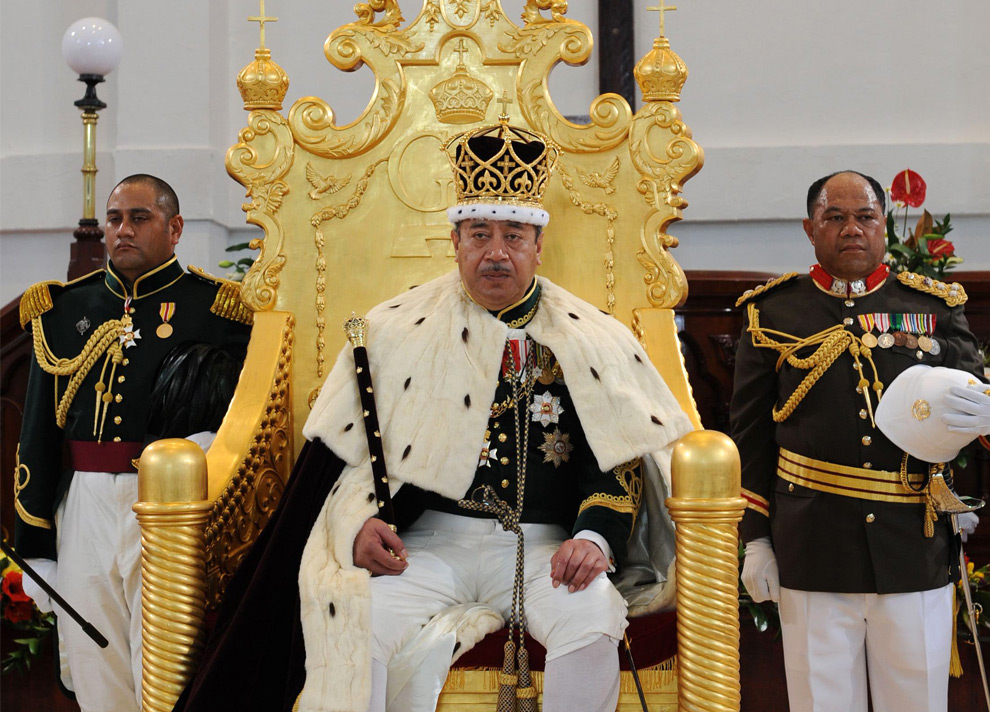

King Tupou VI, in all his glory. Maybe he can be the next Pope,
with the way he's rocking that hat.
Onto the class itself! Starting from basic word elicitation ('what's the word for man?'), we quickly discovered the similarities between the Māori and Tongan sound systems (they both use h, p, t, k, f, m, n, ng, and the same vowels), which include the following general patterns of correspondance (lots of exceptions to the rules; deal with it):

Māori r = Tongan l (toru = tolu = 'three')
Māori w = Tongan v or u (wai = vai = 'water', waea = uaea = 'wire')

As a sidenote, some of the exceptions are pretty cool (rima = nima = 'five/hand', since hands have five fingers). But I digress, as usual.

One thing we're still getting used to is the Tongan sound ', which represents a glottal stop...difficult for English speakers to pronounce word-initially. Try saying the word 'butter' a few times with the cheesiest Cockney accent you can muster, and feel what your throat muscles are doing in the middle of that word. Now try putting that glottal stop at the beginning of a word like ʻanga ('shark'). It's not easy!


So yeah, we're still struggling to pronounce things. But fortunately from the grammar perspective, a lot of the same building blocks we picked up in Māori 101 tend to fall right into place where we expect them in Tongan. This was a big help when we've had to struggle our way through a transcription of 'The Pear Story', which is basically a wordless video meant to encourage storytelling.
But then again...we still haven't fully figured out why the focus particle ko, rather easy to define and use in Māori, is more fluid and resistant to grammatical categorization in Tongan. Or why some sentences include multiple references to the subject pronoun. Or why some verbs mark transitivity with the suffix 'i (e.g. maumau'i = 'to break something', derived from maumau = 'to break) while others use the prefix faka (faka'osi = 'to finish something', 'osi = 'to be finished')...while others employ another strategy entirely. If we had another month or so, we might be able to pin down the details, but for now we're doing the best we can by cobbling together ideas from our knowledge of Māori grammar and our professor's often erroneous guesses (he didn't take Māori with us, leading to some amusing information gaps).

One more cool thing about Tongan before I sign off to be "productive": the definitive accent! In English and Māori, to distinguish between a noun that is definite and one that's indefinite, you just use different articles:

he wahine = 'a woman'
te wahine = 'the woman'

Simple, right? In Tongan, you still stick on an article...but you also change the pronunciation of the word itself! Check this out:

ha ika = 'a fish'
he iká = 'the fish'


In the first word ika, the stress (as it usually does) falls on the second-to-last syllable. In the second word iká, the stress ends up on the last syllable, thus lengthening the vowel and confusing us when we were still struggling to differentiate long vowels from short ones. Anyhow, this might seem pretty dull to you, but I think it's pretty crazy. Hence why I'm writing my final paper on the topic. Yet as I learn more about it, I can't help but think:



Oh well. One more (short) week of elicitation with our ever-patient consultants, then we'll be in the home stretch. Wish us luck!

Thursday, February 14, 2013

Stuck in the Suburbs: The Homestay

Hi again! I hope Hallmark™ Valentine's Day was good to you all.

A can of L&P from my friend Cali, and a yellow
rose from a restaurant called Thai Me Up. Yay.
So I've been really busy all this week, dealing with not only readings and essays for my Anthro class (plus applications for internships) but ALSO our first few sessions of our main Linguistics class, Field Methods. We're studying Tongan, a relative of Māori that is strange and awesome but not the subject of today's post. Instead, let's take a quick tour around my host family's house!

My lovely bedroom (don't worry, I'm fully unpacked by now).
The living room! Note the upright piano in the corner.
Kitchen/dining area, which my housemate Adam and I recently
used to make tacos and quesadillas for our family.
Mmm. Homemade guacamole is best guacamole.
View from the back porch.
The bay behind the house is great to look at; not so much for swimming.
The clouds make cool shadows on the water.
A not-really-secret trail from behind the house into the woods!
Oh hi, crane-like bird.
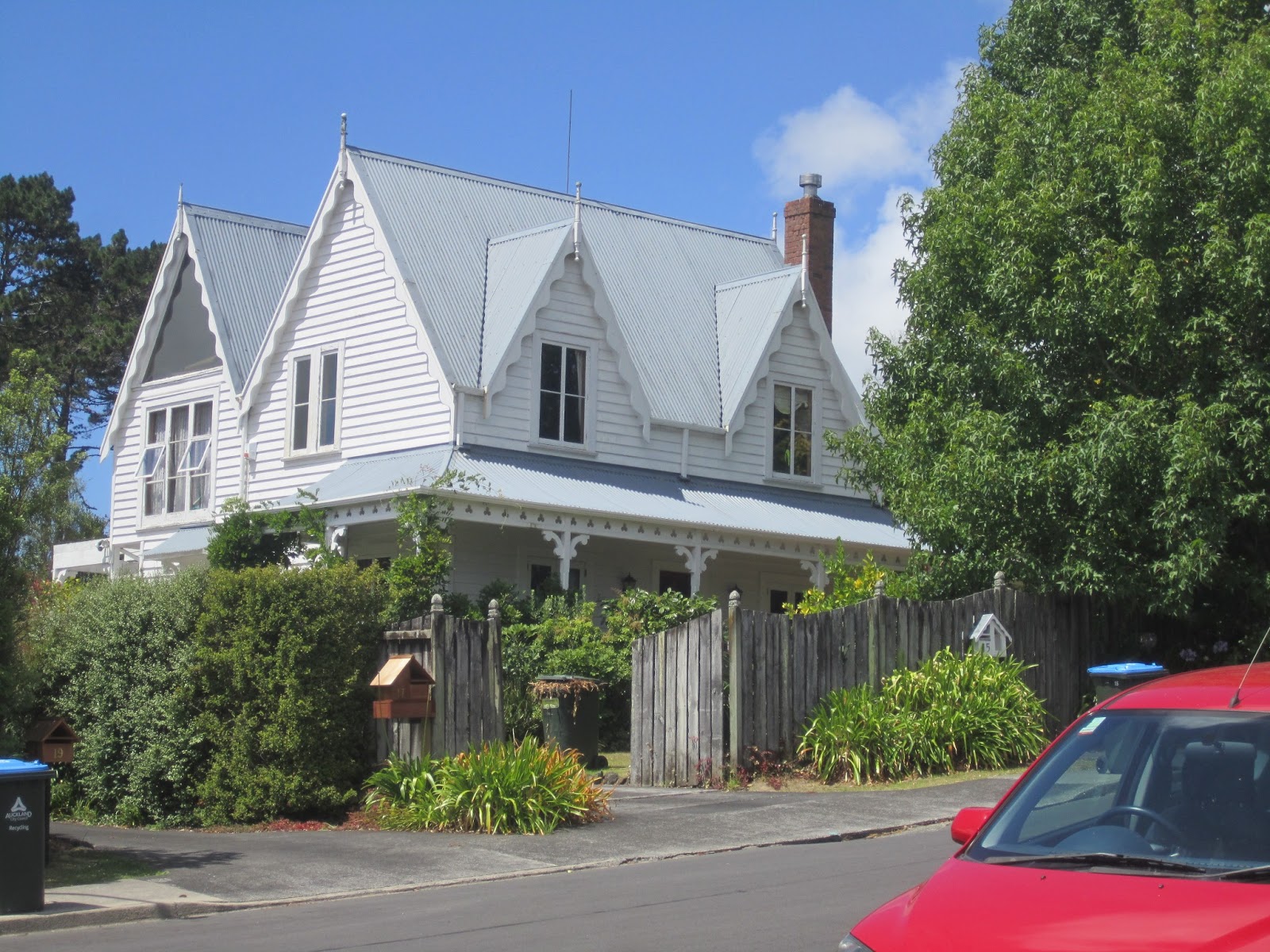
Plenty of cool houses in the suburban neighborhoods.
Apart from the older houses like this, the 'burbs remind
me of Florida.
A little nearby school, with cute multilingual greetings.
The sunset always catches me off-guard.
SO INTENSE
I'm not sure how acceptable it would be to post their names on a public blog, so I'll just use their first initials for now. D and M, the mother and father respectively, are a wisecracking Pākehā couple with four adult sons scattered all throughout the world. She does substitute teaching, he works on airplanes for Air New Zealand, and they both manage to keep busier than most adults their age. I'll frequently get up in the morning to greet D on her way out the door as she bustles off to go walking with a friend, and later come home to find one of them talking to a friend or family member via phone or Skype. 

Still, in the midst of all that, they've made time to get to know us and get us acquainted with various aspects of New Zealand life. For instance, spaghetti on toast! Sounds crazy, but it's easy to prepare and pretty tasty after a long day of chasing buses around the city. Don't knock it before you try it. I hope to expand my repertoire of Kiwi food over the next few weeks (pavlova, please?).

Without reading too deeply into anything, I'd like to think that D and M exemplify a lot of traits commonly ascribed to Kiwis. Hardworking and practical, they have a zeal for travel that's kept them going throughout the years and has given them a lot of great stories. On top of that, they have a penchant for dry wit that always keeps me and Adam on our toes, with such exchanges as the one below:

D: I hope you like your bed.
Me: Yeah, I really like the comforter. I used to have one at home, but we had to get rid of it once it started to smell weird.
D: Well, how long are you here for?

They've also offered a lot of neat insight into New Zealand politics and culture, especially as we've asked them more about Māori issues. It seems that they, like many Kiwis, want to find a middle ground between the ideas of Māori activists and those of the sometimes-sluggish government. Of course, that doesn't make solving problems like land claims any easier, but it does provide perspective on the Pākehā view of these issues. I learn something new from them every day, and I hope it stays that way.

By now, I bet you're wondering what my daily schedule is like. Well, I have a weird class schedule, but here's a rough approximation of a typical day in the life of me:

6:30 AM = Wake up due to sunlight, attempt to sleep in.
7:30-8:30 AM = Roll out of bed and head to the kitchen to make breakfast and lunch.
9:00 - 9:45 AM (on an early day) = Catch the 267 bus into the city to get to the university.
(early day) 10:00 AM - 12:00 PM = LING 54 lecture/discussion with a Māori professor (this week was Professor Mutu) on various aspects of Māori, like this one tricky particle ai
(later day) 2:00 PM - 4:00 PM = ANTH 51 discussion on postcolonial stuff; this week on indigenous issues and the benefits/problems of NGOs
at some point between 12:00 and 2:00 = lunch with the gang, either at an Asian food court or some other fun place
4:00 - 6:00 = studying/hanging out in the library to do readings and homework before heading back to the suburbs
7:00 - 8:30 = dinner and lots of chatting with the host family (usually includes ice cream or other desserts...they are too good to me)
8:30 - midnight = more homework and/or procrastination in the form of watching Downton Abbey (I am addicted...help)

So, yeah! There's a little bit about my life so far, and how I'm often busy but not (yet) overwhelmed. I'm really enjoying my homestay and I hope to keep learning from the family.

If you've gotten this far without falling asleep, here are some more blogs from my fellow FSP-ers! Plus, my sister Lily is road-tripping to Alaska for the Winter World Championships, because she's a boss. Read about her long, cold journey here!

And with all those links, I bid you adieu. Auckland's Pride Festival (the first in 11 years) is this weekend, so lots to look forward to and write about!

Wednesday, January 30, 2013

Hostel: Bay of Islands Edition

Well hello there! I bet you were expecting an update from me sooner, but my head is still spinning from the Māori test I may have just bombed. Anyway, I thought I'd take a moment to put off real work and tell you about our field trip to the Bay of Islands!


A map of where we stayed for most of the trip (Paihia and its environs).


Tuesday, January 22, 2013

The Not-So-Awkward Interviews

How's it going, everyone? I've been surviving my Māori class (our first test was today; pretty easy) as well as kapa haka classes (more on those later) and various extracurricular explorations (let's be honest, I probably won't have time for a separate post on all those). 

Bad news first: my camera appears to have taken its last blurry shot and gone to the great electronics heap in the sky, so all the pictures posted from now on will be from my extremely professional cellphone camera. Or I'll just steal everyone else's photos. Yeah, I think I'll do that.

On the bright side, this is a text-based post (yay reading), since I didn't take any pictures while in the process of...


INTERVIEWING PEOPLE for a class project


For my Anthropology class ("Colonialism and its Legacies in Anthropological Perspective"), we have eight weekly essay assignments based on each week's reading and class discussion, and we have to complete three of them during the term. Pretty simple. Last week's topic was "Postcolonialism as Theory, Method, and Lived Experience," and we had a fascinating discussion on this book, which is basically a montage of experiences among people and cultures (e.g. the Third World) reacting to the official "end" of colonialism.

Anyhow, for last week's assignment we essentially had to address this question: "What does it mean to be a New Zealander?" A very broad question, that could focus on aspects of the country's colonial or Māori history and culture. We had the option of either finding relevant articles online or interviewing real Kiwis.
Since we were feeling a bit ambitious (i.e. uppity), my friend Grace and I decided to go interview people in a local park. We made a big ol' sign that read "Got a minute? Help two students with their project by answering one* short question! *(or more)" and then headed out to get our data.

Here's a gazebo in the park where we interviewed people.
The park also has a giant D. Dartmouth?
We started off by sitting under a tree (for shade) with our sign, and then relocated to a sunnier park bench to attract more customers. Almost right away, we were introduced to a wide range of people: rebellious teens with crazy hair, Japanese tourists, tan shirtless man, Canadian tourists, a guitarist/juggler, a guy with an ambiguous accent, and a Māori/Pākehā man who was probably a drug addict. I was taken aback not only by their friendliness in approaching us but also in their abrupt openness in discussing some pretty intriguing topics. Without too much prompting, these people brought up urban drug culture, the role of nature in New Zealand, multiculturalism in schools, numerous comparisons between countries, socioeconomic disparity, and the difficulty of managing multiple identities (especially when raising children). I could go on and on about the specifics, but I'll spare you the details.

Admittedly, I was initially worried that we, being awkwardly American university students, wouldn't know how to start a conversation with the people who approached us. We did have some trouble with the first one, in explaining what kinds of topics our interviewee could cover while answering the big question. After that, however, we brainstormed some specific prompts to help struggling interviewees (e.g. "What do they teach you about New Zealand in school?") and thereafter achieved much better results.

When beginning to write the paper, I had trouble identifying coherent themes that addressed the question of "being a New Zealander." Therefore, I ended up writing my paper on my impressions of New Zealand "multiculturalism", how it plays into contemporary New Zealand identity, and the difficulty of pinning it down. I'm very hesitant to write or talk about culture in general, but I do enjoy thinking about how different cultures interact, sometimes ignore each other entirely, and very occasionally hybridize. As for what I learned from this assignment...I at least have a lot of new perspectives to apply to my experiences over the next month and a half. It'll be a nice change from the rose-colored glasses that I often don.

On the whole, though, I am really happy that I pushed myself to talk with complete strangers, mostly thanks to Grace and her insistence on doing the interviews. There are a lot of cool stories out there that are waiting to be told.

In other news: Abby is pretending to be a Metapod right now because I buried her in pillows. Good night!

How she puts up with my antics, I'll never know.

Thursday, January 17, 2013

Rangitoto Trip

Sorry about the delay, people! It turns out doing Anthropology research and then writing a paper on it takes a little more time than I originally thought. But I'm back on track (for now) and ready to dish about my trip to Rangitoto Island that happened last Saturday! Since my last post was mostly text, I'm going to let the pictures do the talking this time.

Around 6:30 (ugh) on Saturday, we (Melinda, Grace, Justine, Mitchell, and I) got up and headed north to catch the 7:30 ferry across the bay to Rangitoto. This volcanic island has a pretty interesting story: it erupted out of the sea about 700 years ago in a spectacular pyrotechnic birth that may have inspired its Māori name ("bloody sky"), though the name is also tied to a bloody battle that happened around the same time. Even today, there are footprints left over from Māori people who explored the island soon after the dust settled (perhaps even before the lava fully cooled). Despite its violent origins, Rangitoto has an incredible array of trees, flowers, and birds.
In the 1920s and 1930s (up until the current construction prohibition established in 1937), Pākehā settlers built a number of baches (pronounced "batches") as vacation house. There were also military fortifications built during World War II in preparation for an invasion that never came. After this, the bach owners had a quaint little community that lasted until the late '70s and early '80s, when the residents moved back to the mainland.

Back to the present! We decided on a pretty long route, since we wanted to stay for most of the day: start at Rangitoto Wharf, meander through the kōwhai grove, explore all the empty baches, then head west on Coastal Road toward the Lighthouse, turn right to head up the summit, hit the lava caves on the way down, and finally loop back to take Islington Bay Road back to the Wharf.

Approaching Rangitoto Island!


It's a map! And no, Dora, it's not a talking map.
The kōwhai grove was quite lovely. Even though the kōwhai trees weren't in bloom and there were a lot of spiderwebs (sorry, spiders-whose-webs-we-destroyed), the other plants were cool.

Walking through the grove.
I think that was some kind of moss covering this tree. 
This grass had knots tied into it for some reason.
It's Christmas again! I will never get tired of looking at these Pōhutukawa trees. 
A closeup of the Pōhutukawa flower.
We then proceeded to check out the old baches, which were cute but eerie in their emptiness. It made us feel like we were in a disaster movie, where the area had just been evacuated and the houses left behind.

Pink and portentous.
It looks like someone could just come outside and sit on the porch. 
"Rangitoto is beachcombers paradise"
A barrel behind one of the baches, used to catch rain for drinking water.

Shameless creeping on one of the houses. It's all so neat inside! 
Yes, that is a baby-doll-teakettle-thing on the fireplace.
Otherwise, the room looks quite cozy.
They had weird names.
After a short stop for breakfast along the water, we set off on our circuitous path to the summit. Along the way, we passed by some stunning lava fields and trekked through the woodlands that looked increasingly like rainforest.

Where the lava met the sea. It looked like another planet.

Here's what most of the rocks looked like. They didn't float in water like
pumice stones, but they're probably good for exfoliation, anyway.
Tide pools amid the rock and shrub.
This pool/lake was startlingly green. 
These oystercatchers were all along the water,
chirping and poking about in the sand for food.

Rocks, plants, and water. 
A view of the city from the island. It fits so nicely between those  two big hills! 
Crazy tall trees that bent like no one's business!
Mitchell's not entirely sure what to make of it all.
So he decided to take a break, in his gleaming white clothes.
It's not a snake! Just a bright piece of driftwood hanging out in the lava field.
A very unusual rock formation. Almost like a flower.
Like lightning shooting upward.

I got bored on a beach where we were taking a break.
Now we begin the real ascent to the summit! The boardwalk was much appreciated after so much gravel path.
The rolling hills of Rangitoto's neighbor, Motutapu.

All those stairs...
And here we are at the top! Look at all the friends I have!
Still not sure what that marker thing is.
The crater at the top. As you can tell, it hasn't been active for quite some time.
 After meandering around the summit for a while, we headed back down the mountain to stop by the lava caves for lunch before departing. If we had remembered to bring flashlights (they're called "torches" here...), we could have explored them further, but since we didn't we could only go a short ways into the caves before being stopped by the darkness. Fortunately, we arrived at the caves mere minutes before a tidal wave of other tourists came crashing through, chattering in English, Korean, and Chinese, to do their own spelunking.

Grace, armed with a flash camera, was brave enough to foray deeper into one of the caves.
Creepy but very cool.
Following lunch, we realized that we had less than an hour before the next ferry left (otherwise we'd be waiting another hour and a half for the following ferry). We decided to try and catch the ferry, even though the signs pointing us back to the wharf indicated that the trek would take at least an hour and a half. We ended up running for the last five minutes of the journey, and saw the ferry pulling out of the wharf...but the captains took pity on the sweaty, sunburnt Americans and reversed, letting us hop on board. To celebrate our athletic awesomeness, and parch our quenched throats, we all got smoothies at McDonald's. An unorthodox but happy ending to a marvelous day with friends.

Future updates will come sooner, I promise! My workload is a little lighter this weekend, so blogging/procrastination should happen.